Event sourcing is often overlooked
A lot of people hesitate to adopt event sourcing. The literature is full of distributed systems, eventual consistency, sophisticated event stores, and architectural diagrams that look like they belong at Netflix. It’s easy to walk away thinking this is not for me.
Most of that complexity is self-inflicted. None of it is inherent to event sourcing. It’s a set of choices, and you can make different ones.
The best way to learn is to build
Reading about event sourcing only goes so far. At some point you have to transform theory into practice. And the best way to truly understand how it works is to build your own framework.
The word “framework” can feel intimidating, but it doesn’t need to be. You can start very small. A SQLite database to store events. Serialized classes for projections. The closer you stay to technologies you already know, the easier it is to understand what’s actually happening. You can always make it more sophisticated later, if you ever need to.
In 2016 I wanted to learn event sourcing and CQRS. Broadway, a PHP framework inspired by Axon, gave me a starting point. But I needed to build my own to truly understand. I used a low-risk internal project as a sandbox: a new timesheet and leave request management tool. A real project, real constraints, but nothing critical if things went sideways: at the time, timesheets were still done on paper.
What Backslash is
That project became the foundation of Backslash. And building it from scratch confirmed something important: the fears around event sourcing are largely unfounded once you make deliberate choices about what to include and what to leave out.
Eventual consistency is not a requirement. The event store is a single MariaDB table. Projections are PHP classes serialized into MongoDB. No message broker, no distributed infrastructure. That setup has been running in production for 10 years without problems.
Most applications don’t need to be available 24/7, don’t need to handle thousands of concurrent users, and can tolerate a few minutes of downtime during a deployment. That’s the reality of a lot of software out there, even if the industry rarely talks about it. Backslash is designed for that world.
Backslash is designed for human-scale projects. Not Netflix. Not a team of 50. Just solid, maintainable applications where the domain is genuinely complex but the stack doesn’t need to be.
Ten years in production
Backslash has been put to the test at the Commission de la santé et des services sociaux des Premières Nations du Québec, where I have worked as a software architect for 20 years. It powers several production systems: funding agreement management, income assistance programs, travel requests and timesheets management. More projects are on the way.
None of these are at Netflix scale. They serve real organizations with real domains, and Backslash holds up well at that level.
A recent evolution: Dynamic Consistency Boundary
Backslash worked well for years with classical aggregates. Then I came across Sara Pellegrini’s work on Dynamic Consistency Boundary, and it changed how I thought about the whole thing. DCB remove the need to define aggregate boundaries upfront, which is often the hardest part of event sourcing when the domain is still being discovered.
I immediately understood the value and started refactoring Backslash. The transition was straightforward. Classical aggregates are still supported, but DCB is now the preferred approach.
The Missing Demo Application
One problem with event sourcing in the wild is that most real applications are internal to a company and serve specific business needs. I don’t know of a single finished open-source software product, a CMS, a CRM, anything like that, built on event sourcing. That makes it hard to find a functional reference you can actually run and observe while it’s working.
That’s why I built the Backslash demo application. It’s the app I wish I had when I was learning event sourcing.
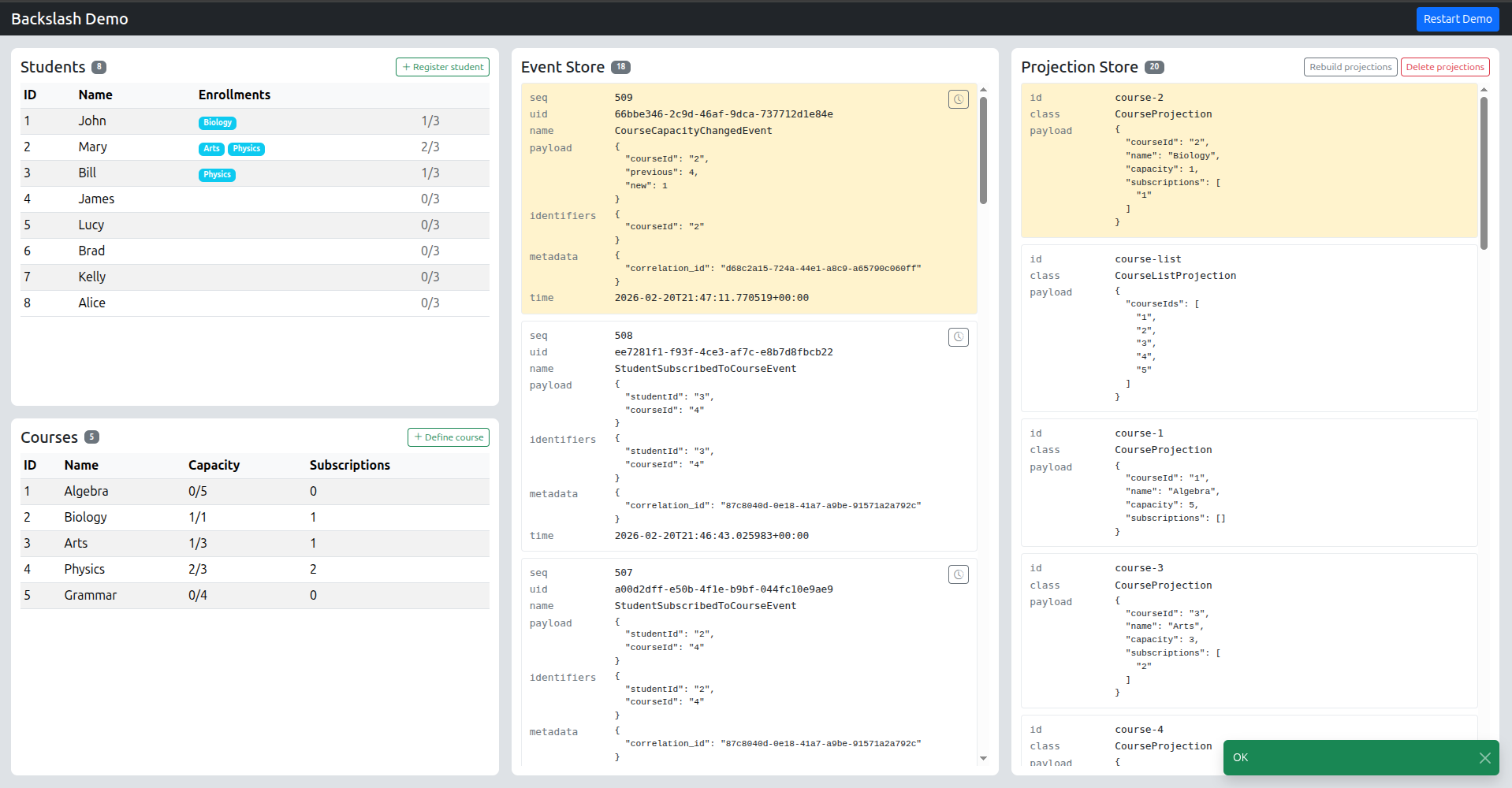
It uses the course subscription domain, a well-known example that highlights exactly where classical aggregates struggle and where Dynamic Consistency Boundary shines. It’s an open window into the inner workings of an event-sourced application.
The code is on GitHub: https://github.com/backslashphp/demo
Clone the repository, run one command, and it’s up.
Happy coding!